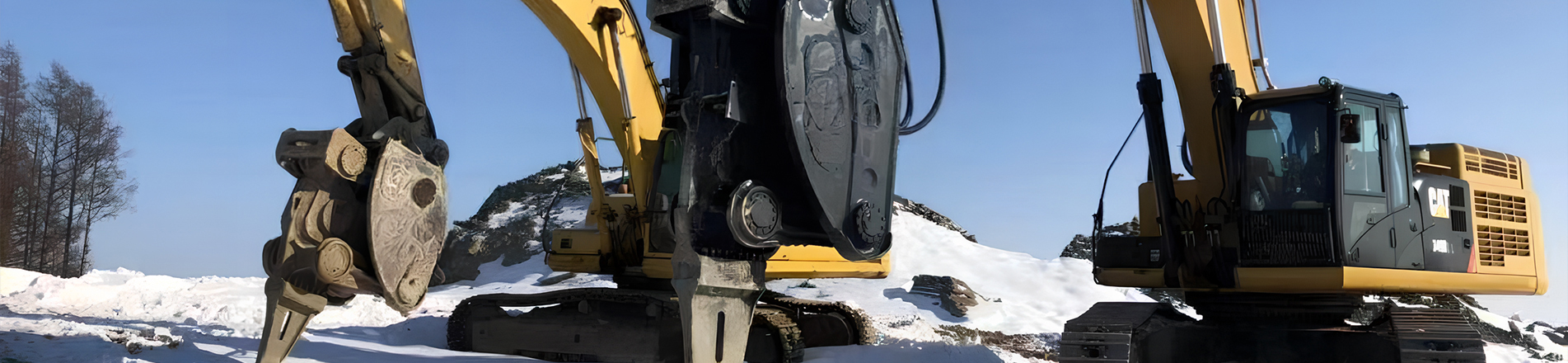
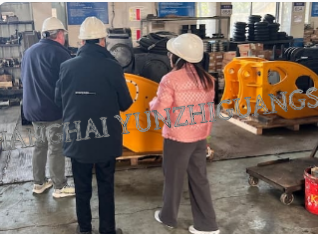
Shanghai Yunzhiguangshu Import and Export co.ltd always focus on attachments & parts of excavator more than 20 years. With positive working attitude,patient after-sale service and reliable quality,we have won the respect and trust of our customers.
Author
Shanghai Yunzhiguangshu Import and Export co.ltd always focus on attachments & parts of excavator more than 20 years. With positive working attitude,patient after-sale service and reliable quality,we have won the respect and trust of our customers.

By May Xie--Shanghai Yunzhiguangshu
Oct 18, 2026
A hydraulic breaker destroys rock—but it also slowly destroys your excavator. In this post, we look at how vibration isolation on a vibro ripper saves your machine.
The Problem: Impact Travels Back
We had a customer in Australia running a breaker on a 30-ton excavator. After 1,800 hours, he had three cracked welds on the boom—repairs cost him more than the breaker itself. That's the hidden cost of impact energy.
A hydraulic breaker doesn‘t just break rock. It sends shockwaves back through the tool, the boom, the arm, and the hydraulic system. Over time, that impact causes cracked welds, leaking seals, and fatigue failure in places you can’t see.
A vibro ripper works differently. It uses high-frequency vibration, not impact. But vibration still has to go somewhere. Without proper isolation, it would travel straight into your excavator.
Modern vibro rippers use rubber damper elements or cushion-link structures between the vibratory housing and the mounting bracket. These components absorb the high-frequency oscillation and prevent it from reaching the boom and arm.
Our SV-50 model uses a patented articulation link with heavy-duty elastomeric cushions. In our lab tests, this absorbs up to 95% of kinetic feedback—vibration stays at the tool tip, not in your boom. The result: your excavator feels a smooth, continuous load—not a punishing series of shocks.
Cracked welds. The No.1 failure point on breaker-mounted excavators. One contractor in Mexico told us he used to budget $12,000 / year for breaker-related repairs. After switching to a ripper, that dropped to under $2,000. The machine simply isn't being shaken apart.
Hydraulic leaks. Vibration loosens fittings and damages seals.
Operator fatigue. Less whole-body vibration means a more alert operator.
Resale value. A machine that hasn‘t been shaken apart holds its value. As a supplier, we always ask our clients to check this before they buy any brand of ripper.
Rubber dampers are wear parts. Ask how often they need replacing—on most models,for example our model SV-50, it’s every 800 to 1,200 hours depending on rock conditions.
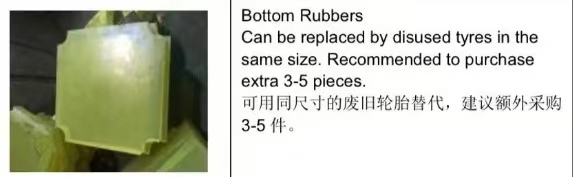
Here’s a field tip from our customers: the bottom rubbers can be replaced by disused tyres cut to the same size. It’s a cheap, effective fix when you’re on a remote site and need to keep running.
We still recommend keeping 3–5 extra pieces in your toolbox. They are small, cheap, and save you days of downtime waiting for a shipment.
Don't let a $50 rubber part turn into a $5,000 shipping bill.
Is it right for your machine?
A vibro ripper protects your excavator—but only if it's the right tool for your ground. In solid unfractured granite, a breaker might still be the better choice. We'd rather tell you that upfront than sell you the wrong attachment.
__________________________________________________________________________________
Next in this series: carrier size—how to match a vibro ripper to your excavator class.
Not sure if your machine can handle a ripper? Tell us your excavator model and application. We‘ll give you a straight answer.